

Science magazine features Palaeolithic engravings from Cova de la Font Major in its print edition
The prestigious international scientific journal highlights the discovery led by IPHES-CERCA in an illustrated news story published in its 12 November issue
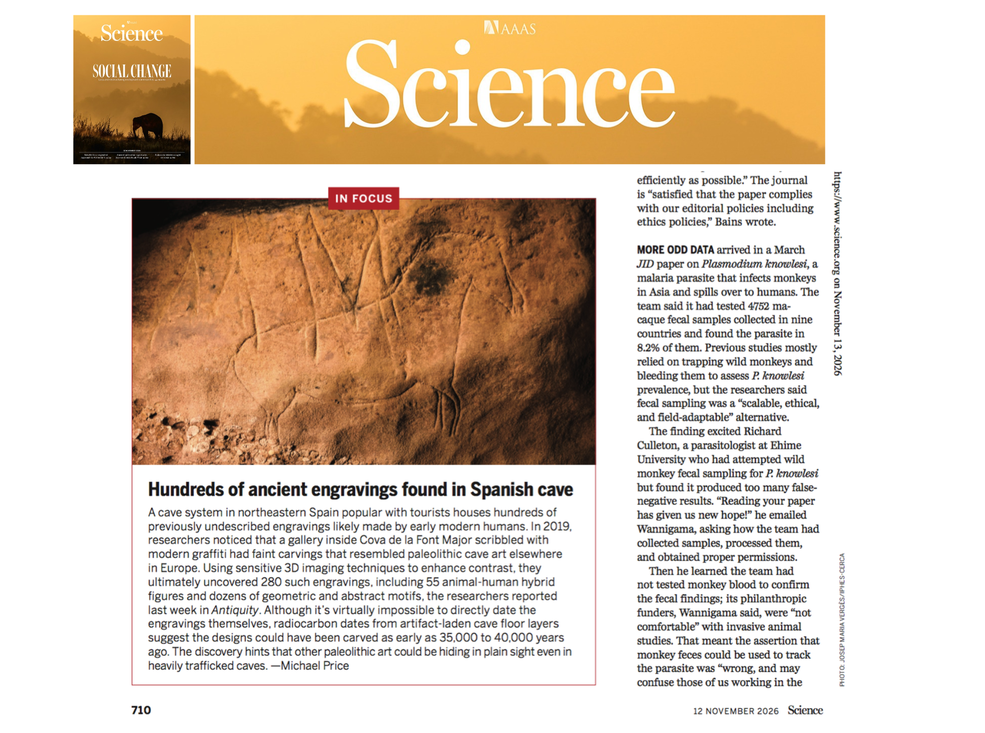
The prestigious international scientific journal Science has featured the discovery of Palaeolithic engravings at Cova de la Font Major, in L’Espluga de Francolí (Tarragona, Spain), in its print edition dated 12 November. The article highlights research led by IPHES-CERCA researchers Míriam Salas-Altès and Josep Maria Vergès, published on 5 November in the scientific journal Antiquity, which documents an exceptional collection of prehistoric rock art.
Under the headline Hundreds of ancient engravings found in Spanish cave, science journalist Michael Price describes how a cave visited by thousands of people over several decades had preserved hundreds of Palaeolithic engravings that went unnoticed until their identification in 2019.
The news story, published in the magazine’s In Focus section, highlights the documentation of 280 engravings using three-dimensional imaging techniques. It also notes that some of these artistic expressions could date back between 35,000 and 40,000 years.
The article appears on page 710 of the print edition of Science, accompanied by a prominent photograph of a Palaeolithic engraving depicting a horse, provided by IPHES-CERCA.
A discovery attracting significant international attention
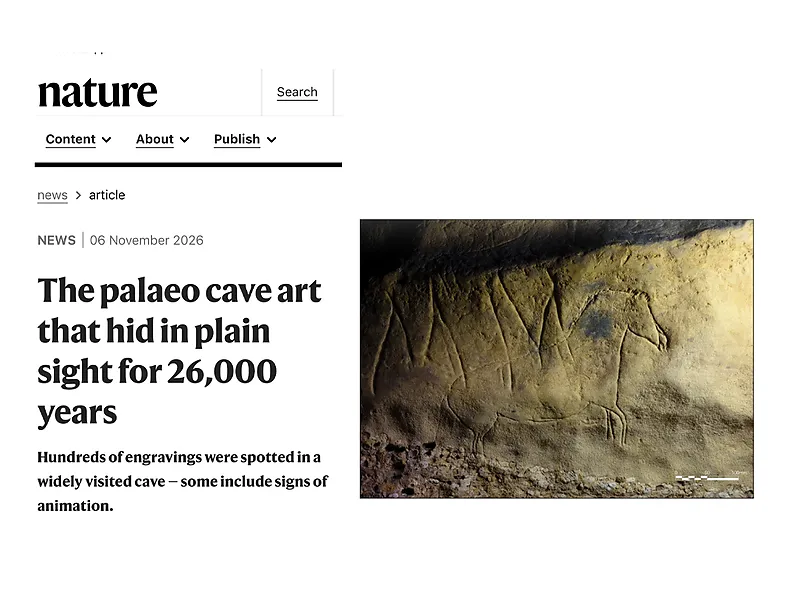
The coverage in Science comes just days after Nature also published an article on the same research, written by science journalist Chris Simms and published on 6 November.
The appearance of this discovery in two of the world’s most prestigious scientific journals, Nature and Science, highlights the international interest generated by this exceptional collection of Palaeolithic rock art and further strengthens the international visibility of the research carried out at IPHES-CERCA.