

IPHES-CERCA presents two decades of research advances on early human settlement in North Africa at a conference in Morocco
Researchers from the centre participated in the 13th Meeting of Moroccan Quaternary Researchers, held in Tétouan, where they presented findings from the Aïn Beni Mathar–Guefaït project and new artificial intelligence-based methods for identifying archaeological sites
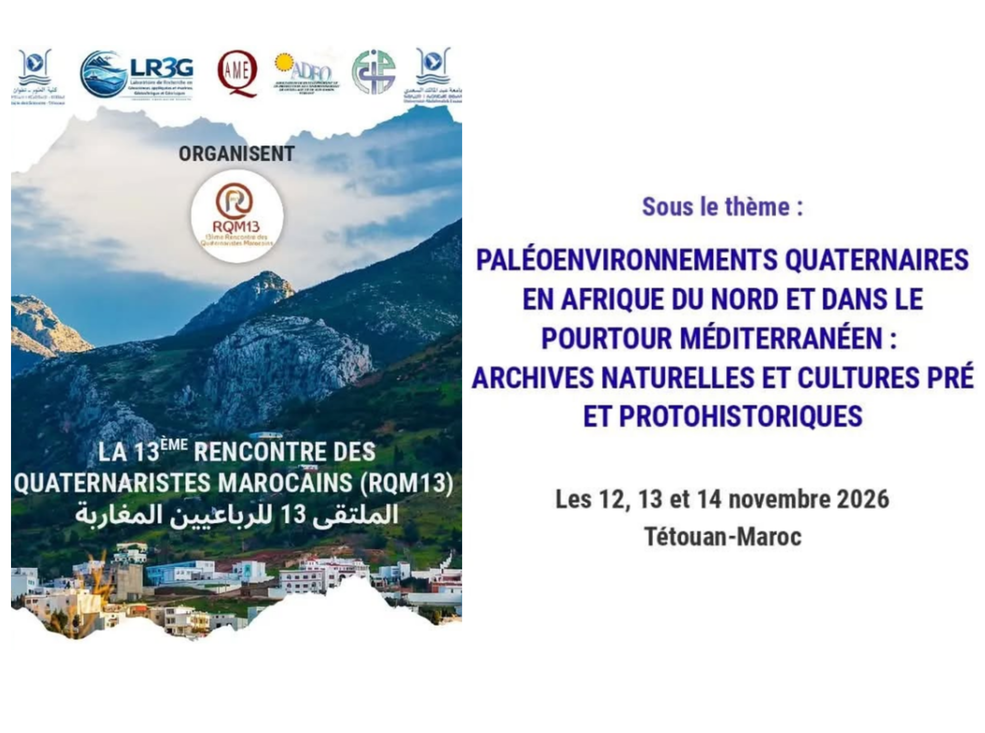
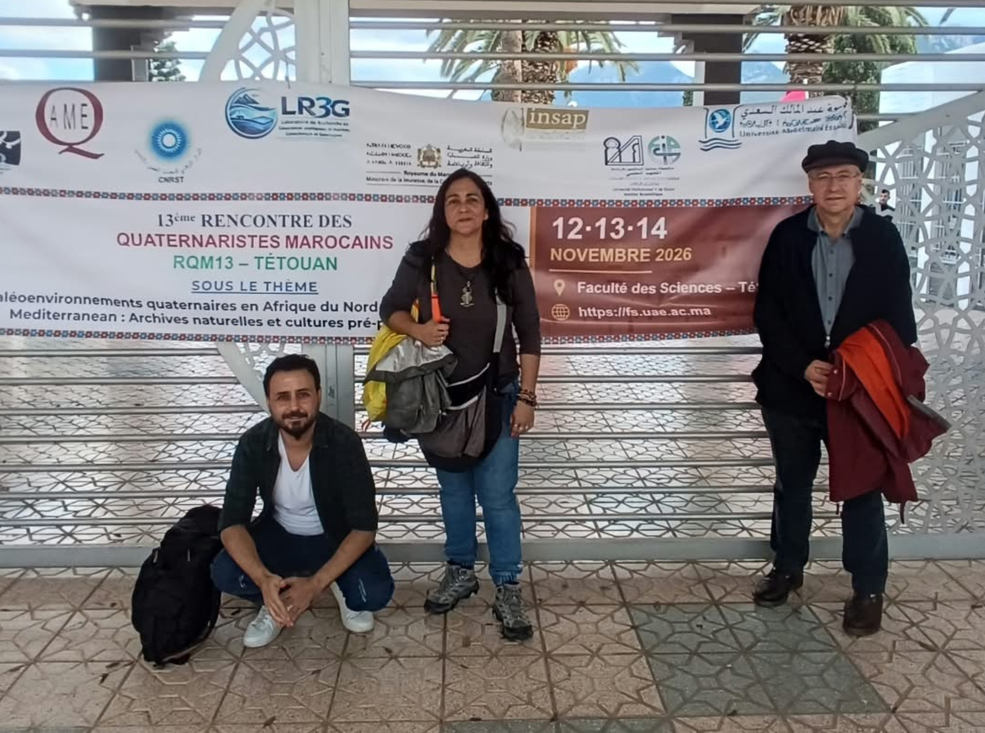
IPHES-CERCA participated in the 13ème Rencontre des Quaternaristes Marocains, held from 12 to 14 November 2026 at the Faculty of Sciences in Tétouan, Morocco. Organised by the Moroccan Association for Quaternary Studies (AMEQ), the meeting brought together around 80 specialists in geology, palaeontology and archaeology to share the latest advances in Quaternary research.
IPHES-CERCA was represented by Dr M. Gema Chacón, Dr Robert Sala-Ramos and predoctoral researcher Mourad Farkouch, who presented two scientific contributions related to the research conducted by the centre over the past two decades in the Aïn Beni Mathar–Guefaït basin, in Jerada Province, eastern Morocco.
The first presentation, entitled Le Plio-Quaternaire d’Aïn Beni Mathar–Guefaït (Jerada, Maroc Oriental), vingt ans d’un projet multidisciplinaire, provided an overview of twenty years of multidisciplinary research in the region. The study highlights the continuity of an international project that brings together different scientific disciplines to deepen our understanding of the evolution of landscapes, ecosystems and early human settlement in North Africa.
The second presentation, delivered by Mourad Farkouch, focused on the application of new technologies to identify archaeological sites. Entitled Predictive Modelling for Sites Detection in the Aïn Beni Mathar–Guefaït Region (Eastern Morocco): A Two-Phase GIS-Based Integrating Machine Learning Approach, the study explores the use of geographic information systems (GIS) and machine learning techniques to develop predictive models that help identify areas with archaeological potential. These tools can guide field surveys and contribute to more efficient planning of future research.
More than two decades of collaborative research with Morocco
Since 2006, the Aïn Beni Mathar–Guefaït basin has been the focus of an international research project co-directed by Dr Robert Sala-Ramos and Dr M. Gema Chacón, from IPHES-CERCA, and Professor Hassan Aouraghe, from Université Mohammed Premier d’Oujda. In 2025, Professor Saïd Bengamra, from the same university, also joined the project’s leadership team as co-director.
The project’s main objective is to investigate the origins of human settlement in North Africa, a key region for understanding evolutionary processes, dispersal dynamics and how early human communities adapted to environmental changes over time.
Over the past two decades, collaboration between Moroccan and Catalan research teams has helped establish a multidisciplinary research programme combining archaeology, geology, palaeontology and landscape studies. Participation in this latest edition of the conference provided an opportunity to share research findings, strengthen scientific ties and ensure the continuity of investigations in this region of North Africa.
The project is made possible through extensive institutional collaboration involving IPHES-CERCA, the Faculty of Sciences at Université Mohammed Premier d’Oujda, the Institut National des Sciences de l’Archéologie et du Patrimoine (INSAP), the government of Jerada, the local authorities of Aïn Beni Mathar and Guefaït, and the Ministry of Youth, Culture and Communication of the Kingdom of Morocco.
The research has received support from the Spanish Ministry of Culture and Sport, the Spanish Ministry of Science, Innovation and Universities through the HUMANCOGNENV project (PID2024-156295NB-I00), the Faculty of Sciences at Université Mohammed Premier d’Oujda, INSAP, the Palarq Foundation, the CERCA programme, the María de Maeztu excellence programmes and the SGR grants awarded by the Government of Catalonia (2025 SGR 01215 and 2023PFR-URV-01237).