

Baza begins its tenth excavation campaign at a 4.5-million-year-old site
A team of 28 people will work for three weeks at Baza 1, where around 3,250 fossils of mastodons, rhinoceroses, primitive horses, crocodiles and other species have already been recovered
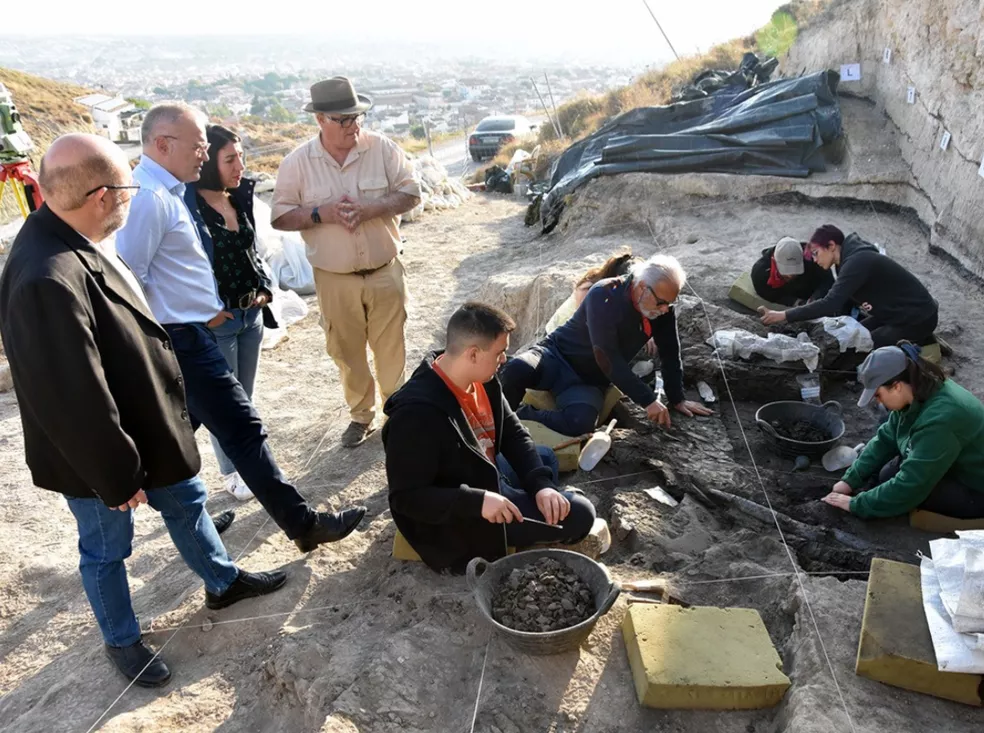
The Baza 1 palaeontological site begins its tenth excavation campaign today. The three-week campaign will run until 11 October, with the main objective of expanding the excavation area and reaching new levels particularly rich in fossils at this 4.5-million-year-old site.
The campaign is led by palaeontologists Bienvenido Martínez-Navarro, an ICREA researcher affiliated with IPHES-CERCA; Sergio Ros-Montoya, from the University of Málaga; and Antoni Canals, an IPHES-CERCA researcher and professor at the Universitat Rovira i Virgili. The work is part of the General Research Project for the study of the Pliocene of the Baza Basin, authorised by the Regional Ministry of Culture and Sport of the Regional Government of Andalusia and funded by Baza City Council.
Expanding the excavation and reaching new fossil-bearing levels
One of the main objectives of this tenth campaign is to significantly expand the excavation area, particularly in the south-western sector, in order to reach the lower levels and, in particular, Stratigraphic Unit 2, which is characterised by its rich palaeontological record.
At the same time, the team will continue working on the upper levels corresponding to Stratigraphic Unit 5, where remains of the mastodon Anancus arvernensis are particularly abundant.
Discovered in May 1996, Baza 1 is an exceptional site for understanding the fauna and environmental conditions of the Iberian Peninsula during the Pliocene. To date, more than 55 square metres have been excavated and around 3,250 fossil remains recovered, including mastodons, rhinoceroses, hipparions (primitive three-toed horses), large carnivores, small mammals, tortoises and crocodiles, among many other species.
Objectives and international participation
This year’s campaign brings together an interdisciplinary team of 28 people, including researchers and students from research centres and universities in Spain and other European countries. Participants include specialists affiliated with IPHES-CERCA, ICREA, Universitat Rovira i Virgili, University of Málaga, Universitat Autònoma de Barcelona, Complutense University of Madrid, University College Cork, University of Pisa, NOVA University Lisbon and the Museum of Jerez de la Frontera, among other institutions.
The work will focus on expanding the excavation of the upper levels, which are particularly rich in proboscidean remains, and reaching the lower levels to determine the thickness and continuity of the fossil-bearing strata. In parallel, work with local authorities and civil society is continuing to enhance Baza 1 as a site open to visitors and as one of the leading palaeontological sites in the Granada Geopark.


