

20 Master’s theses presented in the Erasmus Mundus Master’s Degree in Quaternary Archaeology and Human Evolution
The studies address a wide range of topics and geographical contexts, from human evolution and prehistoric technology to archaeobotany, zooarchaeology, rock art and heritage outreach
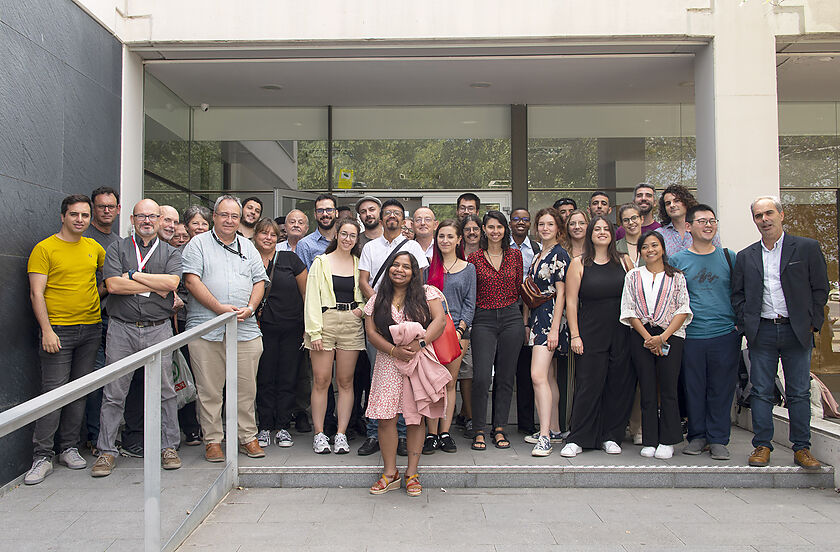
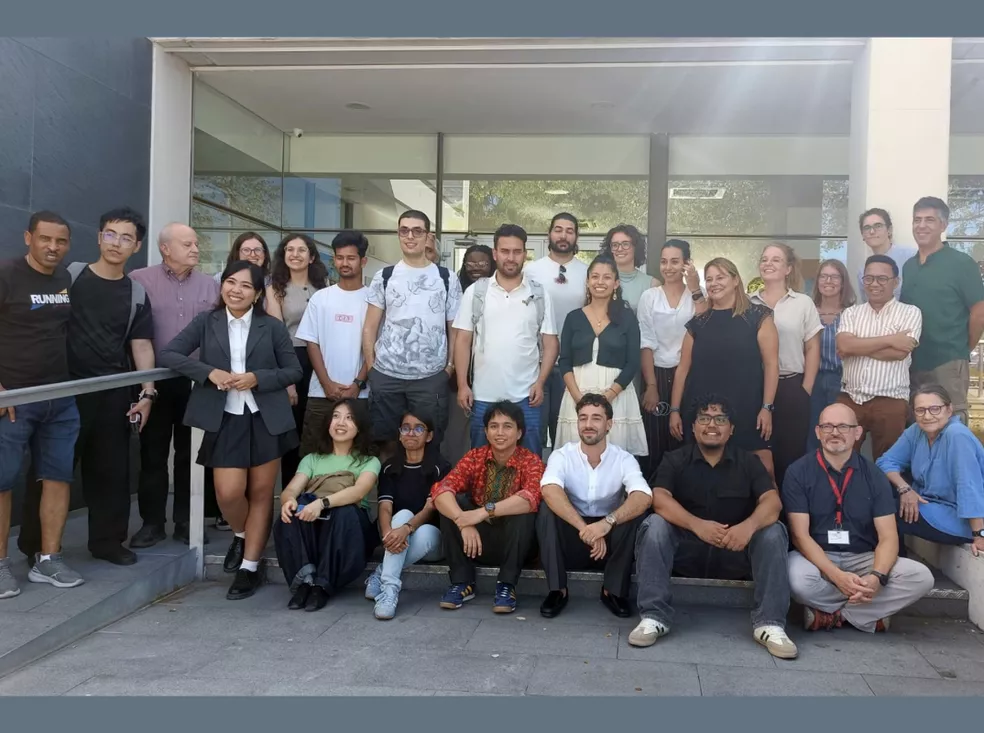
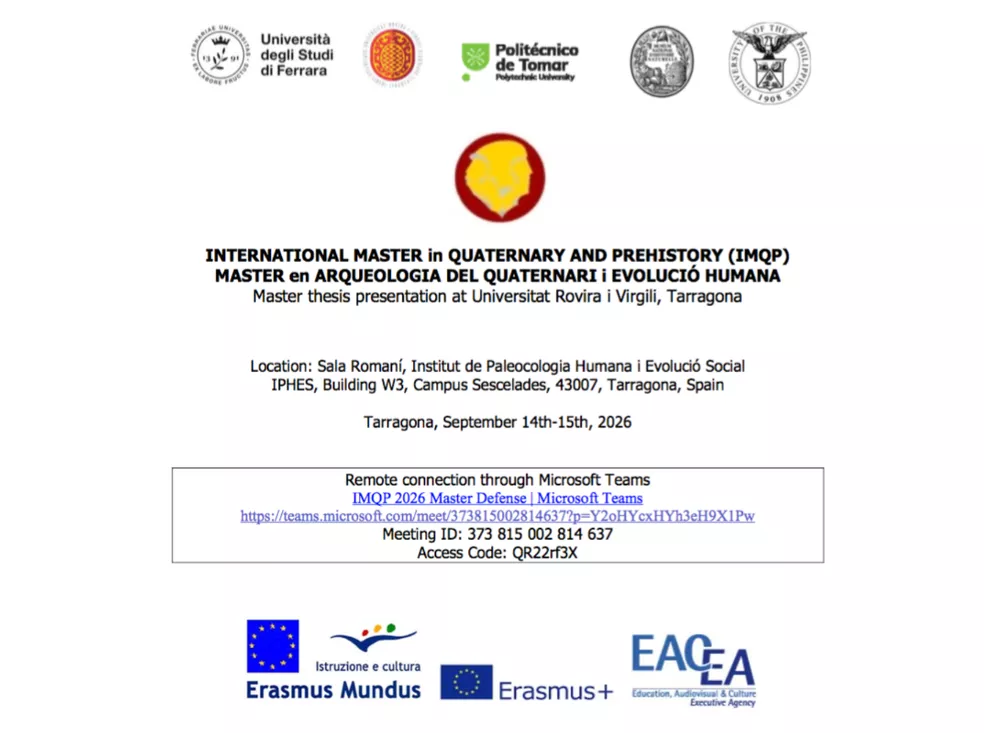
A total of 20 students presented their final research projects for the Erasmus Mundus Master’s Degree in Quaternary Archaeology and Human Evolution (IMQP) on 14 and 15 September 2026 at the IPHES-CERCA headquarters, located on the Sescelades Campus of the Universitat Rovira i Virgili (URV). The thesis defences took place in the Romaní Room, with the possibility of following them online, once again highlighting the programme’s strongly international and interdisciplinary character.
Of these projects, 6 were supervised by IPHES-CERCA researchers, who mentored research in fields as diverse as zooarchaeology, taphonomy, archaeobotany, traceology, physical anthropology and museography.
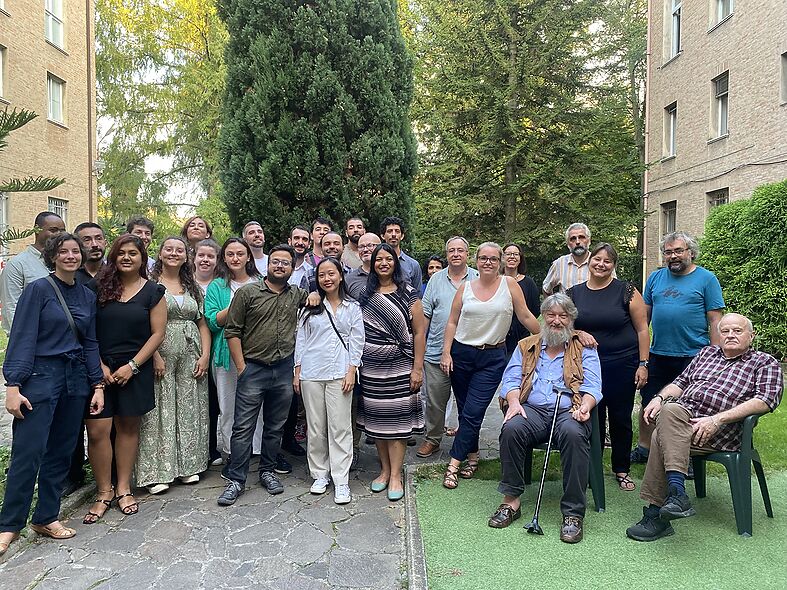
This year’s Master’s examination committee was composed of Dr Marta Arzarello and Dr Julie Arnaud (Università di Ferrara), Dr Christophe Falguères (Muséum National d’Histoire Naturelle, Paris), Dr Sara Garcês (Instituto Politécnico de Tomar), Dr Robert Sala and Dr Carlos Lorenzo (Universitat Rovira i Virgili).
Internationalisation and the Master’s programme’s track record
The Erasmus Mundus Master’s Degree in Quaternary Archaeology and Human Evolution is jointly run by the Universitat Rovira i Virgili, the Università degli Studi di Ferrara (Italy), the Muséum National d’Histoire Naturelle (Paris, France) and the Instituto Politécnico de Tomar (Portugal).
This Master’s programme, which began at the URV in the 2004-2005 academic year, was a pioneer in its field and continues to be a leading programme for attracting international students. Its academic offering has been consolidated thanks to the excellence of the research carried out at IPHES-CERCA through projects around the world, and to its combination of teaching, research, fieldwork and knowledge transfer to society. The Erasmus+ label is a mark of quality that strengthens the international impact of IPHES-CERCA and the URV.
List of students and theses defended
- Putra Hudlinas Muhammad
Combining geomatics and geoarchaeology: long-term topographic evolution of the Semedo area in relation to the distribution and taphonomy of palaeontological assemblages.
Supervisors: Thomas Ingicco, Tara Beuzen-Waller, Igor Girault.
- Ndapewa Julia Shilume
A diachronic analysis of the Basalt lithics for the later stone age site: Seal Rock Shelter (Erongo, Namibia).
Supervisors: Isis Mesfin, David Pleurdeau.
- Ferran Castellón Castellví
The last Magdalenian hunter-gatherers of NE Iberia through lithic technology: the case of Cova Gran de Santa Linya archaeological site.
Supervisors: Manuel Vaquero Rodríguez, Javier Sánchez Martínez.
- Luz Stephanie Rivera Villamarín
The Signature of a Knapper: Tracking Technical Individualities through the Integrated Analysis of Experimental Acheulean Lithic Assemblages.
Supervisors: Amelia Bargalló Ferrerons, Paola García-Medrano.
- Chandan Kumar Rajak
Early Middle Paleolithic Retouched and Unretouched Lithic Tools from Coupe-Gorge (Montmaurin, France): An Approach Combining Techno-Functional and Use-Wear Analysis.
Supervisors: Cyrielle Mathias, Andreu Ollé.
- Mauricio Gastello
Schematic Rock Art of the Abrigo del Águila, Cabeza del Buey, Badajoz, Extremadura, Spain.
Supervisors: Sara Garcês, Hipólito Collado Giraldo.
- Jaime Mir Lapido
A Hunt for Time: Dissecting El Salt’s Unit Xb Through Faunal Analysis and GIS Tools.
Supervisors: Isabel Cáceres, Leopoldo J. Pérez.
- Altayeb Abdalla Hassbrabo Mohammed
Hunter-gatherers living in the changing landscapes of the Sudan during the Holocene: Contribution from lithic use-wear analysis.
Supervisors: Alice Leplongeon, Antony Borel.
- Yuxin Ning
An Analysis of Ethnographic Bone Tools of the Mandan Culture (North Dakota, US) through the Lens of the Technological Approach in Prehistory.
Supervisors: Éva David, François Gendron.
- Alein Mischa de Guzman
Update available: installing gamification and digital routes for prehistoric storytelling applied in the Museu de Arte Pré-histórica e do Sagrado no Vale do Tejo in Mação, Portugal.
Supervisors: Hugo Gomes, Sara Garcês.
- Aurora Patiño-Ochoa
Calcite as ceramic temper in the Early Neolithic at Cueva de El Mirador (Sierra de Atapuerca, Burgos, Spain): an experimental approach to technological choices in ceramic production.
Supervisors: Ethel Ann Allué Martí, Roser Marsal, Josep Maria Vergès Bosch.
- Yemane Meresa
Wood Use in Rural and Urban Settlements during the Pre-Aksumite (800–50 BCE) and Aksumite (50 BCE–700 CE) Periods at Mezber and Ona Adi (Ethiopia): A Comparative Approach through Anthracological Analysis
Supervisors: Ethel Allué, Abel Giralt.
- Tamanna Jahan
Agriculture and Environments in the Bronze Age Indus Valley: Archaeobotanical Study of Chanhu-daro, Sindh, Pakistan.
Supervisors: Margareta Tengberg.
- Maria Sahli
Reconstructing Quaternary Archaeological Fieldwork in the Saoura Valley through the Field Notebooks of Jean Chavaillon.
Supervisors: Roland Nespoulet, Robert Sala.
- Jiageng Chang
A Geometric Morphometric Analysis of the Pozzilli Cranium (Molise, Italy) Dated to the 6th–5th Century BC.
Supervisors: Julie Arnaud.
- Abril Castagnola
Morphological variation of the coxal bone in extant and fossil hominids: Implications for the reconstruction of Ardipithecus ramidus.
Supervisors: Carlos Lorenzo, Julie Arnaud.
- Marta García Ramos
Study of cerebral asymmetries in the genus Homo through the analysis of endocasts.
Supervisors: Carlos Lorenzo.
- Ysé Meltz
Study of human remains from Pinterville in the Eure (Late Neolithic).
Supervisors: Aline Thomas, Julie Arnaud.
- Arturo Giacobbe
Dietary inferences from buccal dental microwear of an Iberian Chalcolithic population: the case of El Golfín (Badajoz, Spain).
Supervisors: Marina Lozano, Raquel Hernando.
- Ghulam Hussain
The Pre- Proto and Historic site of Jardim das Portas do Sol: a contribution for the study of ceramic remains.
Supervisors: Hugo Gomes, Luiz Oosterbeek, Laurent Caron.